

From parameter to phenotype
The statistical assessment determines whether mouse mutants exhibit a significant phenotypic difference from control (or wildtype) mice for each parameter measured. When the difference is significant, an onotology term is assigned to describe the phenotype. As the phenotype calls are made on parameter basis, the results should be considered in the context of the procedure the parameter is part of.
The particular Mammalian Phenotype (MP) Ontology terms that can be associated with a parameter are specified in IMPReSS. Often, an increase or a decrease of the parameter can be determined. However, in some cases, the direction cannot be determined and so the called phenotype only indicates a general abnormality.
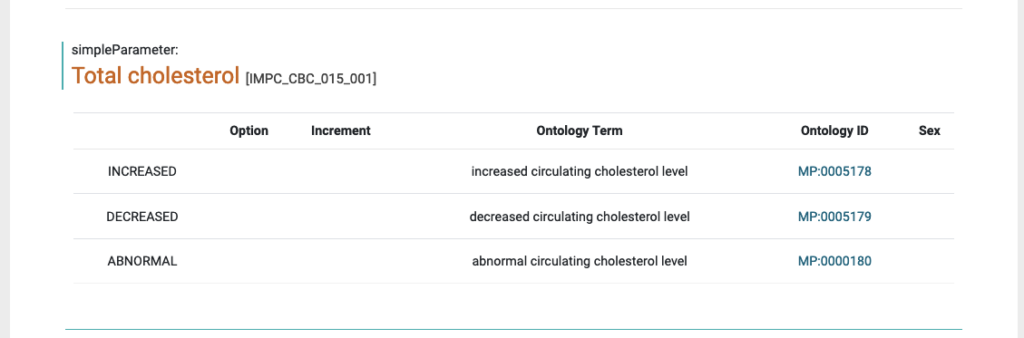
To identify the direction of the effect, a statistical metric called the “estimate” is used. This is the model coefficient from the final adjusted model, adjusted for the fixed effects, random effects, and weight structure that were retained in the final model. In other words, the estimate accounts for soft windowing, body weight (if included as a covariate), and the underlying data structure.
If the estimate > 0, the assigned MP term is “increased”. If the estimate < 0, the assigned term is “decreased”.
In rare cases, it may appear that an incorrect MP term has been assigned to the observed outcome on the chart, for example, “increased” where “decreased” would be expected, or vice versa. This can occur because the chart does not account for whether body weight was used as a covariate, or for the complexity of the model used to derive the estimate.
The summary statistics table contains means and standard deviations calculated across the whole dataset, including data outside the soft window, which may also give the appearance of an incorrect MP term being assigned.